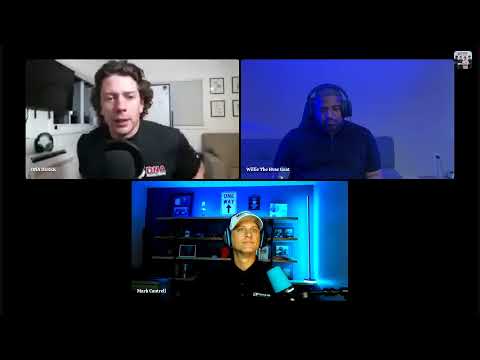
April 15, 2026 · Live Q&A 2h 6m
Networking, Maintenance Contracts & Financing Strategies with Joel Verley
Joel Verley of Triangle Trade Pros in Raleigh joins Willie and Mark to cover networking-first growth, multi-trade licensing strategy, the free maintenance plan model, Profit First banking, and every financing option available to HVAC contractors today.
Meet the Hosts & Guest
Who's on this episode

Guest
Joel Verley
Owner, Triangle Trade Pros · Raleigh, NC
Residential HVAC contractor with 15 years in the industry. Holds HVAC and electrical licenses and is pursuing plumbing licensure to build a true multi-trade operation. Approaching his first full year in business, Joel built his customer base almost entirely through networking — including hosting his own monthly branded event called Rockstar in the Raleigh area.

Host
Willie Ward
Owner, GOAT Heating & Cooling · HVAC IS LIFE Founder · Charlotte, NC
Charlotte HVAC owner and founder of the HVAC IS LIFE community. Hosts the HVAC IS LIFE Podcast and co-hosts the weekly Live Q&A.
Jump to section
- [0:34]Joel Verley & Triangle Trade Pros — Building a Multi-Trade Business in Year One
- [4:13]Networking as the Primary Growth Engine
- [6:09]One Right Handshake Can Generate $750,000 — Real Examples
- [15:59]Indoor Air Quality Upsells — The MVP Framework
- [17:25]Building Confidence for Networking Events
- [19:54]Hosting Your Own Networking Event — Becoming the Star
- [24:01]HVAC Licensing Across State Lines
- [32:34]When to Hire Your First Technician
- [35:17]Maintenance Contracts as the Foundation for Growth
- [1:09:12]Consumers Are Price Conscious — Financing Is the Answer
- [1:11:15]Stand Firm on Your Prices — They Have the Money
- [1:25:16]Financing Options for HVAC Contractors
- [1:28:35]Profit First System and Relay Bank
- [1:32:37]Joel's Free Maintenance Plan Model
- [1:38:38]Willie's $100 Maintenance Contract — The Strategy Behind It
- [1:52:52]Is Your Company's Value Tied to Its Maintenance Contracts?
- [1:57:00]Government Contracting — The Real Story
- [2:00:18]When Should an Owner Stop Using Tools?
Joel Verley & Triangle Trade Pros — Building a Multi-Trade Business in Year One
Joel is approaching his first full year running Triangle Trade Pros in Raleigh, NC. Fifteen years in the industry gave him the technical foundation. He already holds an HVAC contractor license and an electrical license, and he is actively pursuing his plumbing license through a North Carolina rule that allows HVAC licensees in good standing for over ten years to qualify for the plumbing two exam. Not to change toilets — to add water treatment and complement his core HVAC business.
When he needs to move a water heater to access an HVAC system, he can quote the replacement on the same visit. When a customer switches from gas to electric and needs a 240 circuit, he runs it himself. Each license adds what he can quote on a single visit without a subcontractor.
"Licensing is very important. There are a lot of advantages once you get that license. Opportunities are boundless."
Actionable Takeaway
Research your state's cross-licensing pathways. Many states allow HVAC licensees to add electrical or plumbing credentials with far less testing than starting from scratch.
Networking as the Primary Growth Engine
Joel runs no paid advertising. His business has grown almost entirely through structured, intentional networking — BNI, local Raleigh area networks, and his own monthly branded event at Redino's restaurant in Knightdale that he has run for over a year.
The key insight most contractors miss: networking events are technically B2B, but every person in that room lives somewhere. Every lawyer, realtor, and accountant has a house with an HVAC system. The B2B conversation becomes B2C revenue once they have experienced your service. Mark — a digital marketer — said his number one recommendation to every HVAC contractor is still to network first, because the right handshake does more than months of ad spend.
"It really only takes like one good person that you need to meet and it can change the whole game."
Actionable Takeaway
If you are not attending at least one structured networking event per month, start there. BNI and local chambers are consistent and established. Track every customer source and compare acquisition cost from networking versus digital channels.
One Right Handshake Can Generate $750,000 — Real Examples
Joel told a story that stopped the room. At a networking event, he met a multi-business owner who owned real estate and multiple commercial strip malls. Over three years, that one relationship produced over $750,000 in revenue. The client even pre-bought 45 HVAC units and stored them to lock in 410A equipment before the refrigerant transition.
That relationship came from Joel making the conversation about the other person — asking what he could do to help, not pitching himself. He does not get something from every meeting, but the compounding effect of consistent presence turns into calls. Mark added that when someone meets you and then recommends you to a neighbor, that neighbor searches your name — which is why networking and Google presence work together, not separately.
"I met one person and it's been a quarter million, half a million dollars worth of revenue. It's all about shaking the right hand."
Actionable Takeaway
Go to one networking event this week and make it entirely about the other person. Ask what they do and what kind of referral would actually help them. Do not pitch. Do this consistently for three months and track what comes back.
Indoor Air Quality Upsells — The MVP Framework
Joel uses a framework he calls MVP to explain indoor air quality in a way that lands with homeowners. M is moisture control — humidity and dehumidification, year-round, not just summer. V is ventilation — introducing clean outside air so the home is properly pressurized and not pulling in pollutants through broken seals. P is particulate matter — filtration and ionizers that cause particles to clump and become easier to capture.
The framework works because it turns a vague technical category into terms any homeowner already understands. Willie reinforced the core principle: whatever IAQ product you choose to sell, you have to understand it deeply and genuinely believe in it. Customers can feel the difference.
"You want to control the moisture all year round, not just in summer. You want it in winter too."
Actionable Takeaway
Build the MVP walkthrough into every maintenance visit. You are not selling on every visit — you are educating. The customer who understands the framework calls you when they are ready to act on it.
Don't miss the next one
Get every new Q&A in your inbox
Live episode alerts, key takeaways, and resources from each guest — every other Thursday.
Building Confidence for Networking Events
A viewer named Justin asked how to build confidence for networking events. Joel's answer: know your business, know your intention, and make every conversation about the other person. Confidence problems usually come from worrying about what to say about yourself. Flip it — ask about them.
Willie added that if you lack confidence doing something you do for a living, you probably do not fully believe in what you are selling. Confidence is a byproduct of belief, not a personality trait. Mark's take was the most practical: get the repetition in. Force yourself to go even when it is uncomfortable. Bring a guest if it helps. Do whatever gets you out of your own way, because all growth happens outside your comfort zone.
"All your growth happens outside your shell. I promise you that."
Actionable Takeaway
Commit to one networking event per week for four weeks. Before each one, set a goal of three genuine conversations where you ask more questions than you answer. Track conversations, not leads.
Hosting Your Own Networking Event — Becoming the Star
Joel's most powerful networking move is one most contractors never consider: he stopped attending other people's events and started running his own. His monthly event is called Rockstar. When people come, they are coming to see him. He is the reason everyone showed up.
That changes every interaction — people approach him, conversations come to him, and the trust that comes with being the host follows him into every business relationship that forms in that room. The cost is low. A private room at a local restaurant and a consistent date each month. The compound value of being the person who brings the community together is enormous. People remember who created the room long after they forget who attended it.
"If you are the star, everybody's there for you. It just flips the whole vibe."
Actionable Takeaway
If you have been attending the same events for six months, you already know enough people to start your own. Pick a local restaurant, set a recurring date, and invite your contacts. Ten people at your event is worth more than being one of fifty at someone else's.
HVAC Licensing Across State Lines
Joel is already planning multi-state licensing so his business can move with him if he ever relocates. In the Southeast, if your North Carolina HVAC license is in good standing, getting licensed in South Carolina requires only passing the business and law exam. The same pathway applies in Georgia, Texas, and Mississippi, with minor variations.
Some states may not even require a test — just proof of license in good standing and the application fee. Tennessee has no statewide requirement at all, with only some cities setting their own rules. In markets with low or no licensing requirements, your license is a competitive differentiator worth putting on everything — the truck, the website, every invoice.
"Licensing is an opportunity. Once you have it, opportunities are boundless."
Actionable Takeaway
Look up your state's HVAC license reciprocity agreements today. If you are in the Southeast, there is a strong chance you can add South Carolina, Georgia, or additional states with minimal testing.
When to Hire Your First Technician
The question came from the live chat. Joel's answer was structured: first, do you have office staff? If not, hire office before field. A dedicated CSR — even a virtual assistant — who answers phones, responds to emails, and handles admin will accelerate the business faster than adding a truck.
Joel hired a virtual assistant through a service called Magic when he launched Triangle Trade Pros. She had a bachelor's degree, handled all administration, and the business grew because someone was on the phones all day while Joel ran calls. Once coverage is in place, the signal to hire a technician is simple: your schedule is full and you cannot keep up. And season matters — if it is April and you are already stretched, hire now. You have not hit peak season yet.
"Once I hired office staff, the business skyrocketed. You have somebody dedicated, and it shoots everything up."
Actionable Takeaway
Before posting a technician job listing, ask: is someone answering my phone and email every hour of the business day? Fix that first. Use your maintenance count divided by three daily visits to calculate how many days of guaranteed work you can offer a new hire.
Maintenance Contracts as the Foundation for Growth
Both Joel and Willie returned to maintenance contracts repeatedly because the math keeps pointing to the same place: a contractor with a large maintenance base has predictable revenue, predictable scheduling, and a built-in pipeline for repair and replacement work.
Joel tracks his contracts manually inside House Call Pro with notations on each client record. He acknowledged it gets hard past a hundred contracts and nearly impossible past two hundred. Willie admitted he has forgotten clients who then reminded him — his response is to do the visit free and reset the relationship. The bigger point both made: maintenances reveal heat exchangers and bad compressors on older equipment. Those are not maintenance revenue — those are system replacement conversations that only happen because you had a reason to be in front of the equipment when no one was panicking.
"Maintenance is the key. Those are your customers. That's your fan base."
Actionable Takeaway
Tag every customer record with equipment age. Systems over ten years old should be scheduled at the start of each shoulder season — before you are slammed — because those visits are most likely to turn into installs.
Consumers Are Price Conscious — Financing Is the Answer
A viewer named Seth said his business was suffering because customers are trying to spend less. Willie and Mark pushed back on the framing. The problem is rarely that customers do not have money — it is that contractors are not making it easy enough to spend it. A $15,000 system replacement feels like a crisis as a lump sum. Presented as $200 a month, it feels like a utility bill.
Willie made the point more directly: customers have HELOCs. They have equity in homes that have appreciated significantly. When a customer says they cannot afford it, they often mean they have not been shown a path that feels manageable. Financing is that path. Mark noted that finance companies will likely get creative again as the economy tightens — during COVID, Service Finance ran a plan where customers qualified and made no payments for twelve months. That kind of offer moved equipment faster than any discount ever could.
"Don't let them customers fool you. They got the money. They just don't want to give it to you."
Actionable Takeaway
If you do not currently offer financing, set up at least one option this week. Present financing on every install quote — not as a fallback, but as a standard part of the first presentation.
Stand Firm on Your Prices — They Have the Money
Price confidence came up again with Joel in the room. Willie's message was direct: if you could knock on a thousand doors there is no way you cannot close sales. The issue is not the market — it is the contractor's confidence in the room. Clients can smell hesitation. When you present a price with certainty and stop talking, the silence is on them.
Joel added his own read: pay attention to what the client has around them. Apple iPhone, maintained yard, nice car in the driveway — you are talking to someone with standards. Speak to that standard. Mark's point: if a client pushes back and you feel the need to respond, add value — throw in a media filter, a surge protector, something that costs you less than the discount would. Never move the price. The moment you do, you have told that client and everyone they talk to that your prices are negotiable.
"If you could knock on over a thousand doors, there is no way you cannot close no sales. You just got to get in that door."
Actionable Takeaway
Before your next sales call, say your price out loud ten times followed by silence. The discomfort with silence is what makes contractors fill that silence with discounts. Practice holding it until the client speaks first.
Financing Options for HVAC Contractors
Joel laid out the financing landscape from the perspective of a contractor in year one. Most premium financing companies want at least one to two years of business history. Hearth was the exception — willing to work with Triangle Trade Pros early on, with an upfront fee model rather than per-transaction charges. Service Finance remains the gold standard for established businesses — multiple plan types and creative structures including historical deferred-payment promos. GreenSky is a solid alternative.
Joel described his previous company running financing like a car dealership — multiple lenders stacked so if a customer did not qualify for the top tier, they moved to the next, all the way down to a lease structure at the bottom. The goal was always to find a path to yes.
"You can pay $100 a month. I get it low for you, baby. You got financing options."
Actionable Takeaway
Set up a financing stack with at least two lenders at different qualification thresholds. When a customer says they cannot afford it, your next sentence should be a monthly payment number — not a price reduction.
Profit First System and Relay Bank
Joel discovered this system through ChatGPT and implemented it immediately. It solves the most common financial problem in contracting: money comes in, expenses go out, and at the end of the month there is no idea where the profit went. The system requires five bank accounts. Income — nothing comes out, only receives. Operating — for expenses. Tax. Owner's pay. Profit. Every time revenue hits the income account, a set percentage automatically distributes to each of the other four. Joel's splits: 60% to operating, 20% to tax, 15% to owner's pay, 5% to profit.
The bank is called Relay — free online banking with unlimited accounts, each with its own routing number, and automatic percentage transfers between them. The psychological shift is what makes it work: when you pay for something, you look at the operating account only. If it is running low, that is a pricing signal — not a reason to pull from the tax account.
"It's going to help you see that in order to set this much aside, you need to be charging more."
Actionable Takeaway
Open a free Relay account this week and create five sub-accounts: Income, Operating, Taxes, Owner Pay, Profit. Set automatic distribution percentages. Even imperfect splits are better than a single account where everything blurs together.
Joel's Free Maintenance Plan Model
Joel's maintenance program is free to join. Customers sign up with no upfront payment and no commitment. He captures their information and an optional appointment booking. When he shows up and does the maintenance, they pay then. Pay as you go. The psychology is intentional — no barrier to getting their name on the list, no prepaid obligation for Joel to fulfill when it is 110 degrees and he is running emergency calls.
He built an automated system in High Level that sends seasonal outreach, prioritizes systems over ten years old at the start of shoulder season, and lets customers book through a link. The system runs without him. The only thing he wants in a customer's mind is: I have a maintenance plan with Triangle. When their system breaks, they call him before they open Google.
"All I really want is for them to know — I have a maintenance plan with Triangle. That's it."
Actionable Takeaway
If customers resist signing up for a paid maintenance plan, try a free-to-join model. Build a simple signup page, connect it to your CRM, and focus on getting names on the list. A free maintenance customer who refers two neighbors is worth more than a $100 contract that never renewed.
Willie's $100 Maintenance Contract — The Strategy Behind It
Willie's approach is different but arrives at the same destination. His contract is $100 for the year with two cleaning visits included, no filters. He does not make money on it and does not try to. He compares the $100 to advertising spend — if you are throwing money at digital ads with uncertain returns, why not invest that energy in the customer already in front of you?
He has built 500 residential contracts on this model. When a compressor fails six years in, that client does not get three quotes — they call Willie. That $12,000 replacement is what the $100 annual contract made possible. Every maintenance visit is treated as a sales opportunity without pressure: a standardized checklist that includes media filters, air scrubbers, surge protectors, Wi-Fi thermostats, and more. If the customer is not ready today, it goes on their record for the next visit.
"I sacrifice the time to come out there, but I'm going to check everything and offer everything. If you don't want it now, I'll catch you on the next maintenance."
Actionable Takeaway
Whether your plan is free like Joel's or $100 like Willie's, build a standardized checklist for every visit with at least five potential upsell observations. Note what you see, present it factually, and let the customer decide on their timeline.
Is Your Company's Value Tied to Its Maintenance Contracts?
Mark asked Joel directly: is a company only worth as much as its maintenance program? Both Joel and Willie engaged honestly. Maintenance contracts represent recurring customers — loyalty already demonstrated. A buyer is not just buying equipment and a name. They are buying 500 customers who have proven they pick up the phone. That is a different asset than equivalent revenue with no recurring relationships.
The counterpoint Willie raised: some contractors build highly profitable businesses on installs alone. They grow fast, run lean, and sell at a high multiple. But that model depends on marketing spend that must continue indefinitely. A maintenance-based business keeps generating service opportunities even when you pull back on advertising. The right answer depends entirely on what you want the business to do for your life.
"The bigger you grow your maintenance base, the more valuable your company is."
Actionable Takeaway
If you plan to sell your business in the next five to ten years, treat your maintenance list as a balance sheet asset today. Document every contract, tag every system with age and condition, and build renewal automation so it runs without you.
Government Contracting — The Real Story
Joel looked into government contracting after his cousin at the City of Raleigh encouraged him. The paperwork requirement stopped him cold: RFPs asked for his team's combined years of experience, individual manager resumes, insurance levels exceeding what a small shop carries, and wage structures that might require raising employee compensation to meet government thresholds.
Not because government work is bad — it can be steady and lucrative — but because doing it wrong once creates compliance problems that follow your license. Mark added that government contracts often push contractors toward W-2 employees and away from the flexibility small shops depend on. Every layer of compliance has overhead, and that overhead has to be factored into whether the margin actually makes sense for your business size.
"I would love to hire somebody that can bring that kind of work to the business. I just can't take it on my plate right now."
Actionable Takeaway
Do not pursue government contracting without first talking to a contractor who has done it in your state. Find the inside guidance before you start the application — not after.
When Should an Owner Stop Using Tools?
Willie's answer cut through the fantasy: everybody he knows doing two to four million a year is still working. When things get swamped, the owner goes back in the field. Joel reframed the question in a way that landed harder: the day you step away from HVAC tools, you pick up a different set. Spreadsheets, reporting, personnel decisions, HR conversations. Running a team means you are running a people company now, not an HVAC company. The tools change but the work does not stop.
Both agreed the path to actually stepping back requires two things first: a sales system or salesperson who replaces you as the revenue generator, and a general manager who can run daily operations from the playbook you built. Without both, you stepping back just means the business slows down.
"Once you become an owner with people working underneath you, you're no longer running an HVAC company. You're running a personnel company now."
Actionable Takeaway
Before you think about stepping back from the field, document your entire sales process. That document is what you hand to the first salesperson or use to train technicians to close. You cannot leave the field until the replacement system is built and proven.
Featured Quotes
"It really only takes like one good person that you need to meet and it can change the whole game."
"All your growth happens outside your shell. I promise you that."
"If you believe in that brand, that's how you let clients believe into your brand."
"Don't let them customers fool you. They got the money. They just don't want to give it to you."
"Once you become an owner with people working underneath you, you're no longer running an HVAC company. You're running a personnel company now."
"I met one person and it's been a quarter million, half a million dollars worth of revenue."
Questions Answered
Click a timestamp to jump to that moment on YouTube.
Featured Resources & Sponsorship
Tools, offers, and partners from this episode
Episode Sponsor
Free consultation + 10% off all services for HVAC IS LIFE listeners.Upward Bound Media
HVAC-specialized SEO, websites, and digital marketing — built by people who actually know the trade.
Tools & products mentioned
Financing
Works with contractors in year one. Upfront fee, no per-transaction charge.
Financing
Multiple plan types, best for established businesses.
Financing
Strong alternative for qualified customers.
Banking
Free online business banking. Unlimited sub-accounts, automatic percentage transfers. Purpose-built for Profit First.
Book
Profit First — Mike Michalowicz
The system behind separating income, taxes, owner pay, and profit into five accounts.
CRM / Automation
CRM and marketing automation Joel uses for evergreen maintenance scheduling, seasonal outreach, and online booking.
Network
BNI — Business Networking International
Structured local referral networking. Private equity is not there. You should be.
Want to reach HVAC pros?
Sponsor a future episode of HVAC IS LIFE.
Guest Resources
Joel Verley
Owner, Triangle Trade Pros · Raleigh, NC
Residential HVAC contractor with 15 years in the industry. Holds HVAC and electrical licenses and is pursuing plumbing licensure to build a true multi-trade operation. Approaching his first full year in business, Joel built his customer base almost entirely through networking — including hosting his own monthly branded event called Rockstar in the Raleigh area.
Topics
Subscribe for more
Never miss a live Q&A.
HVAC IS LIFE airs every other Thursday. Hit subscribe on YouTube and join the email list for episode alerts and show notes.
Email alerts
Get the next episode in your inbox.
Related Episodes
More Q&As from the crew.

June 11, 2026
The Godfather of IAQ — John Ellis on UV Lights, Dustfree, Maintenance Calls & Mentorship
IAQ legend John Ellis of Dynamic Air Consulting joins Willie and Mark to walk through the complete service call and maintenance call life cycle, the real science behind UV lights, how to price maintenance agreements profitably, the Dustfree DF-16, and the torchbearer philosophy from a 45-year career.

May 14, 2026
Zone Dampers, Flat Rate Pricing & Getting Leads as a Solo Operator
No guest this week — just Willie and Mark going deep on what the community brought to the chat. Zone system dampers, pricing confidence, refrigerant band-aids, Google reviews, and a real conversation about what it takes to hold your price when a client pushes back.

April 30, 2026
HVAC Price Fixing Lawsuit Deep Dive + Proven Business Strategies for Contractors
21-year HVAC veteran Michael James Johnson breaks down the price fixing lawsuit against Trane and Carrier, the 454B refrigerant crisis, monthly pricing strategy, and the boots-on-the-ground marketing that beats private equity.